
 Perion (soon)
 NUMANumismatics platform
 Bark-AITurn data into profitEmotions AIAI & real-time visualization
What Emotion Looks Like
An AI-driven exploration of how the emotional layer of conversation can become something we can examine, interpret, and think through.
Concept visualization01 / The Project
What If Emotion Could Be Seen— and Touched?
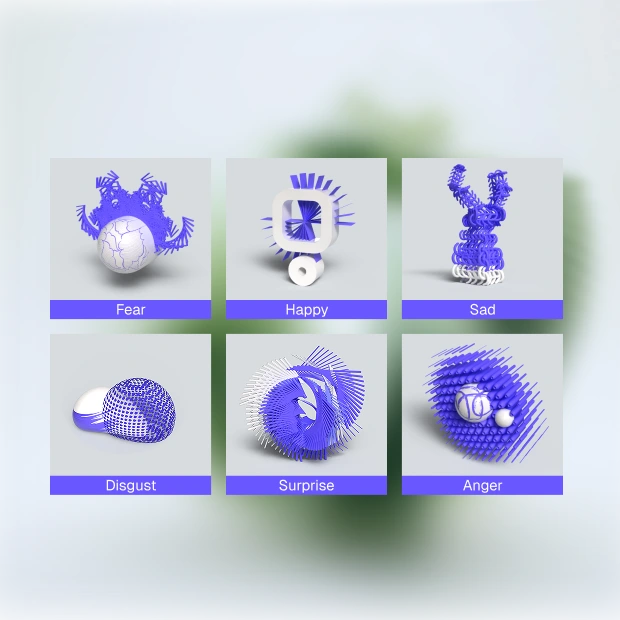
The system uses AI to interpret emotions expressed through voice—such as happiness, sadness, surprise, fear, anger, and disgust—and translate them, alongside conversational dynamics, into an evolving visual language. Through a visual dictionary, each emotional state takes on a distinct form—turning spoken emotion into a tangible object that can be observed and experienced in real time.
- Medium
- Voice AI
- Method
- Emotion Recognition
02 / Framing the Design Challenge
From Vocal Signals
to a Visual Language of Emotion
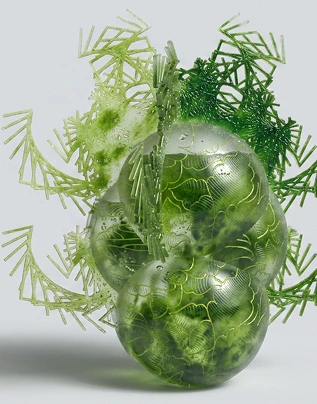
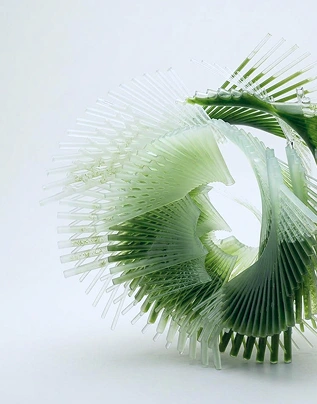
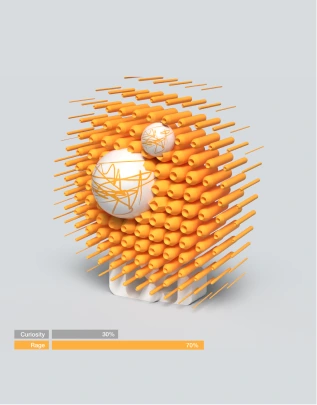
Paul Ekman’s six basic emotions provide a starting point for the visual dictionary. The design challenge is to express emotion through form, color, texture, and movement: how can a representation be clear and accessible while leaving room for personal interpretation? An abstract visual language allows for open-ended meaning, while a recognizable character may make the emotion easier to understand and invite identification. Three-dimensional forms were chosen to give emotion weight and presence in space. As the project develops, it explores how this presence, together with the visual choices, can invite children to observe, interpret, and talk about emotion. Further exploration will examine the role of texture and the possibility of children choosing a representation from a predefined set or drawing what the emotion looks like to them.
03 / Research & Technology
Emotion recognition relies on multiple acoustic dimensions to translate spoken nuance into real-time visual form.

Prosodic signals
Pitch, rhythm, intensity, and speech rate.
Spectral features
Centroid and bandwidth capturing vocal texture.
MFCCs
Frequency structures used by ML models to detect patterns.
These signals provide probabilistic emotional cues rather than an absolute measure of feeling.
04 / Prototyping the Experience
Forming a Visual Language
The concept was brought to life through three conversations. In each one, the emotional signals within the voices shaped an evolving visual composition in real time. Seen together, the conversations reveal different emotional rhythms: moments of intensity and restraint, repetition and interruption, distance and connection.
05 / Designing for reflection,
not diagnosis
The visualization offers an interpretation, not an objective truth. Abstract forms preserve ambiguity, inviting people to notice patterns, shifts, tensions, and connections without defining exactly what someone feels.
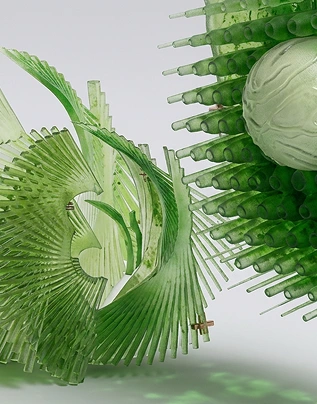
Selected experiments in form, texture, and movement.
06 / Research Foundations
The research draws on academic literature in speech emotion recognition, social psychology, and visual communication. Qualitative interviews with a psychoanalyst and a social psychologist helped shape the project’s direction and explore its potential for reflection.
An initial prototype was developed at Shenkar’s Interaction Lab.
View the initial prototype
